← BACK_TO_LOG

Production from a Parking Spot

Produção a Partir de um Lugar de Estacionamento

Production from a Parking Spot

Production from a Parking Spot

"The office is wherever I park. Production is somewhere I haven't been in years."

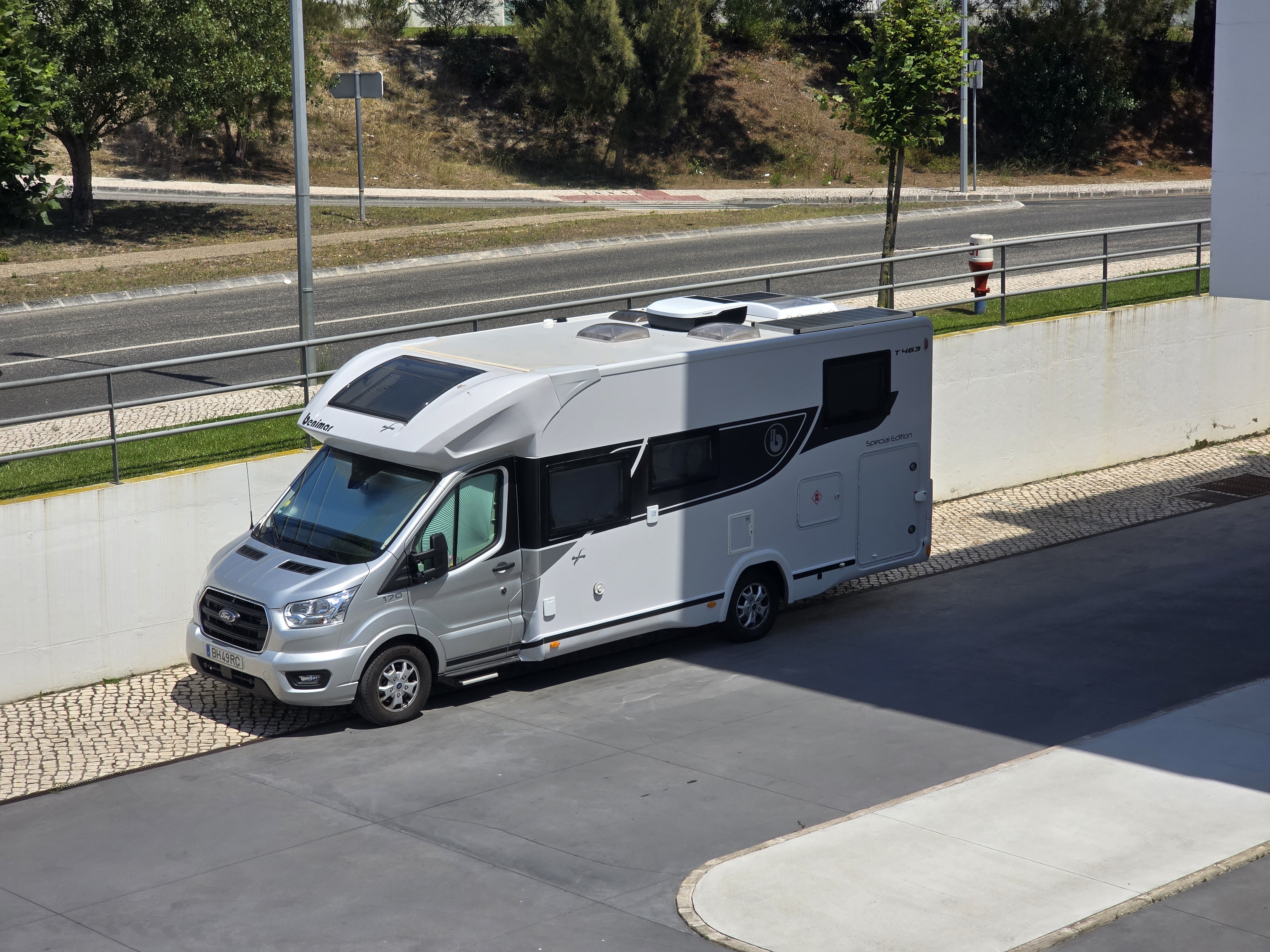
Right now, this laptop is open on the dinette of a 2024 Benimar T463 Special Edition. Jolie is asleep on the bench. Le is in the kitchen, six feet behind me. Outside, Caldas da Rainha, Portugal. Inside, rogerle.com servers are serving traffic to clients on three continents, and none of them are in this motorhome.

That's the whole post in one sentence. The office is here. Production lives elsewhere. People conflate the two, then ask me how the internet survives when we move.

🛰️ Office vs. Infrastructure

The motorhome is a workstation. The servers are in a datacenter that doesn't move.

It sounds obvious. It isn't — because when people read "manages a hosting business from a motorhome," their imagination puts the racks behind the bench seat. Nobody who's actually run a server thinks that. You don't put production on a vehicle that loses power every time you forget to plug in the EHU.

What lives in the motorhome:

  • The development machines — Mac primary, Linux Mint laptop as backup, iPad Pro for off-hours.
  • The deploy pipeline. tar czvf package.tar.gz, scp, ssh into AlmaLinux, --strip-components=1, chown -R nginx:nginx, restart php-fpm.
  • The thinking.

What does not live in the motorhome:

  • nginx serving traffic.

  • MariaDB holding data.

  • The DNS records pointing rogerle.com at anything.

Get that distinction wrong and you build the wrong architecture. Get it right and you can park anywhere with a clear view of the sky.

🔌 Power and Signal

Office workers don't think about either of these. Motorhome operators think about them constantly.

Power. Two leisure batteries, solar on the roof, EHU when the campsite gives me one. Laptop battery is for emergencies — not for an eight-hour SSH session. If the inverter is off, I'm reading docs on the iPad and saving real work for later — or firing up the Bluetti power station if I actually need to ship something.

Signal. Starlink mini, mounted on skylight, online wherever the sky is open. The exception is Portugal — when we're home, it's local cellular and fiber. Three years ago this paragraph would have been about hunting signal, multi-SIM rigs, and learning where carrier coverage maps lied. Today it's a non-issue ninety-five percent of the time. Tree cover, heavy weather, narrow valleys can still take you offline — and when they do, the old habit kicks back in: queue the work, deploy when you can.

🛠️ The Toolkit

Lean on purpose. Things break when you carry them around in a vehicle.

  • Mac primary. Chrome and Firefox. Tabby for SSH.
  • Linux Mint laptop as second machine. Same tools, different keyboard, for when the Mac is charging.
  • iPad Pro for reading, admin checks, ticket triage.
  • vi for editing on the server. Nano is for tourists.
  • Vanilla PHP, vanilla JS. That's the default, not a religion. I'm trying Laravel + Alpine + Tailwind on a new project right now to see what they offer. Production stays vanilla until something clearly beats it. After thirty years, I'm still curious about the next thing — that's how I got here in the first place with the help of the Awesome Crew (Claude AI).
  • tar.gz packages. The whole deploy is four commands and a verification curl. No CI/CD. No build pipeline. No Docker.

If the runway is short and the connection is sketchy, complexity is the enemy.

⚠️ What Breaks

In rough order of frequency:

  1. Starlink drops mid-SSH. Solved with mosh or accepting the session is gone.
  2. Power browns out because the fridge cycled and the inverter is on the edge. Solved by knowing the motorhome better than your laptop knows it.
  3. Le needs the table for dinner. Solved by closing the laptop. Production keeps running.

That's the list. Three years in, I expected more.

🧱 What Doesn't

The servers. They don't break, because they're not in the motorhome, and because I treat them like they need to survive without me. Uptime monitoring runs from a third location and pings me through the helpdesk. Logs rotate. Backups happen on a schedule that doesn't ask permission.

The discipline of working from a parking spot makes the infrastructure better, not worse. You can't SSH in to fix something at three in the morning when Starlink is sulking and Le is asleep on the other side of the curtain. So you build it so you don't have to.

🧭 The Point

"Production from a parking spot" doesn't mean production lives in the parking spot. It means the operator does — and the operator's job is to make sure the operator can leave.

Everything I've built for thirty years has been quietly preparing for this. The vanilla stack. The tar.gz deploys. The discipline of doing one thing at a time. The reason it works isn't the motorhome. It's the years of choosing simple things on purpose.

This is just where I'm sitting today.


*Written from Caldas da Rainha, Portugal, with Jolie asleep on the bench and Le making coffee. All systems operational from the bench seat.*

Produção a Partir de um Lugar de Estacionamento

"O escritório é onde eu estacionar. A produção está num sítio onde não vou há anos."

Neste momento, este portátil está aberto na mesa de uma Benimar T463 Special Edition de 2024. A Jolie dorme no banco. A Le está na cozinha, a uns dois metros atrás de mim. Lá fora, Caldas da Rainha. Cá dentro, os servidores da rogerle.com servem tráfego a clientes em três continentes — e nenhum deles está nesta autocaravana.

É o post inteiro numa frase. O escritório está aqui. A produção vive noutro lado. As pessoas confundem os dois, e depois perguntam-me como é que a internet sobrevive quando nos mexemos.

🛰️ Escritório vs. Infraestrutura

A autocaravana é uma estação de trabalho. Os servidores estão num datacenter que não se move.

Parece óbvio. Não é — porque quando as pessoas leem "gere um negócio de alojamento a partir de uma autocaravana", a imaginação delas coloca os bastidores atrás do banco. Ninguém que já tenha gerido um servidor pensa isso. Não pões produção num veículo que perde energia sempre que te esqueces de ligar a ficha elétrica.

O que vive na autocaravana:

  • As máquinas de desenvolvimento — Mac principal, portátil Linux Mint como backup, iPad Pro para fora de horas.
  • O pipeline de deploy. tar czvf package.tar.gz, scp, ssh para o AlmaLinux, --strip-components=1, chown -R nginx:nginx, reiniciar o php-fpm.
  • O pensamento.

O que não vive na autocaravana:

  • O nginx a servir tráfego.
  • O MariaDB a guardar dados.
  • Os registos DNS que apontam o rogerle.com para alguma coisa.

Erra essa distinção e constróis a arquitetura errada. Acerta nela e podes estacionar em qualquer sítio com uma vista limpa do céu.

🔌 Energia e Sinal

Quem trabalha de escritório não pensa em nenhum dos dois. Quem trabalha em autocaravana pensa neles constantemente.

Energia. Duas baterias auxiliares, painéis solares no tejadilho, ficha elétrica quando o parque ma dá. A bateria do portátil é para emergências — não para uma sessão SSH de oito horas. Se o inversor está desligado, leio documentação no iPad e guardo trabalho a sério para mais tarde — ou ligo a Bluetti se precisar mesmo de fazer deploy de alguma coisa.

Sinal. Starlink Mini, montado na claraboia, online onde quer que o céu esteja limpo. A exceção é Portugal — quando estamos em casa, é rede móvel local e fibra. Há três anos este parágrafo seria sobre caçar sinal, montagens multi-SIM e descobrir onde os mapas de cobertura das operadoras mentiam. Hoje é um não-problema noventa e cinco por cento das vezes. Cobertura de árvores, mau tempo, vales apertados ainda te podem deixar offline — e quando deixam, o velho hábito volta: põe o trabalho em fila, faz o deploy quando puderes.

🛠️ As Ferramentas

Magras por princípio. As coisas partem-se quando andamos com elas num veículo.

  • Mac principal. Chrome e Firefox. Tabby para SSH.
  • Portátil Linux Mint como segunda máquina. Mesmas ferramentas, teclado diferente, para quando o Mac está a carregar.
  • iPad Pro para leitura, verificações de admin, triagem de tickets.
  • vi para editar no servidor. O nano é para turistas.
  • PHP vanilla, JavaScript vanilla. É o padrão, não uma religião. Estou a experimentar Laravel + Alpine + Tailwind num projeto novo para ver o que oferecem. A produção continua vanilla até que algo a supere claramente. Trinta anos depois, ainda tenho curiosidade pelo próximo passo — foi assim que cheguei aqui, com a ajuda da Awesome Crew (Claude AI).
  • Pacotes tar.gz. O deploy inteiro são quatro comandos e um curl de verificação. Sem CI/CD. Sem build pipeline. Sem Docker.

Se o tempo é curto e a ligação é fraca, a complexidade é o inimigo.

⚠️ O Que Parte

Por ordem aproximada de frequência:

  1. O Starlink cai a meio de uma sessão SSH. Resolvido com mosh ou aceitar que a sessão se foi.
  2. A energia cai porque o frigorífico ligou e o inversor está no limite. Resolvido por conhecer a autocaravana melhor do que o teu portátil a conhece.
  3. A Le precisa da mesa para o jantar. Resolvido fechando o portátil. A produção continua a correr.

É a lista. Três anos depois, esperava mais.

🧱 O Que Não Parte

Os servidores. Não partem porque não estão na autocaravana, e porque os trato como se tivessem de sobreviver sem mim. A monitorização de uptime corre num terceiro sítio e avisa-me pelo helpdesk. Os logs rodam. Os backups acontecem num horário que não pede licença.

A disciplina de trabalhar a partir de um lugar de estacionamento torna a infraestrutura melhor, não pior. Não podes fazer SSH às três da manhã para corrigir alguma coisa quando o Starlink está a fazer birra e a Le dorme do outro lado da cortina. Por isso constróis as coisas para não teres de o fazer.

🧭 O Ponto

"Produção a partir de um lugar de estacionamento" não significa que a produção vive no lugar de estacionamento. Significa que o operador vive — e o trabalho do operador é garantir que o operador se pode ir embora.

Tudo o que construí em trinta anos esteve, silenciosamente, a preparar-me para isto. A stack vanilla. Os deploys em tar.gz. A disciplina de fazer uma coisa de cada vez. A razão pela qual funciona não é a autocaravana. São os anos de escolher coisas simples de propósito.

Isto é só onde estou sentado hoje.


*Escrito em Caldas da Rainha, Portugal, com a Jolie a dormir no banco e a Le a fazer café. Todos os sistemas operacionais a partir do banco.*
← How Two Retirees Use AI as Crew